On Finishing …

the endFor twelve years I have been working on a trilogy of fantasy books. In that time I have lived in two different countries, three states, and six different homes. I’ve had eight jobs, gotten a Master’s degree, and gone through one marriage, one divorce, and two deaths in my family. Through it all I have been writing, among other things, this single epic tale. During the process, moments of boundless enthusiasm and despair mixed with long periods of just moving forward, doing the work, writing the next scene, the next chapter, the next book.

Last week I wrote THE END. I finished the last chapter of the last book and sat back, stunned by the moment and the magnitude of what I’d done. I had before me a single complete story spanning 300,000 words, roughly 1200 pages, and the occasion has gotten me thinking about finishing things, and endings in general.

I’ve talked with a lot of new and young writers who say they enjoy writing, but have trouble finishing anything. The reasons vary. Sometimes writers get stuck on a problem they never solve, or lose interest in what seems like an idea that didn’t pan out. Sometimes their story isn’t really a story, but rather a series of events with no central conflict demanding an ending. Sometimes writers just lose faith, or have a moment of doubt that brings their work to a halt and they never go back to it.

If the problem is technical, there is probably a solution if you work to find it, but sometimes the problem is psychological, a reluctance, for whatever reason, to finish. Either way, if you’re passionate about writing, you must persevere to an ending. At the very least so you get practice writing them. We all know a story must have a beginning, a middle, and an end. That’s why writing short stories is such good practice for the craft as a whole. They provide an opportunity to practice endings nearly as much as beginnings and middles.

Elizabeth Engstrom says to “find your ending in your beginning.” I always think about this when I’m coming to the end of a story. It’s important to end the story you started writing, and not some other story you picked up along the way. A strong central conflict really helps make this clear. The end must match the beginning in a way, and I found this to be just as true in a 300,000 word story as in a 1500 word story. The end must deal with the same protagonist, issues, and conflicts introduced in the beginning. So if you’re searching for an ending, that’s a good place to start.

When you get there at last, there’s nothing quite like the feeling of finishing a work of fiction. There’s a bit of magic in fiction, a sense of creating something tangible from the nebulous dreamscape of your mind. And when the last sentence is written, especially if it’s a good one, there’s a sense of triumph and relief like no other. If your project happened to take twelve years like mine did, there’s also a bittersweet sense of loss. All the unwritten scenes and plot puzzles and character arcs I carried around with me day after day … they’re all resolved now. The story is finished.

The work is far from over, of course. I already have a number of other projects I’m working on, and in a week or two I’ll dive back in for more editing and rewrites. Eventually, I’ll start thinking about the next big project, and what I want to accomplish in the next twelve years!

_

*Simultaneously published on ShadowSpinners.

A Picture is Worth (x) Words

Everyone’s heard the saying “a picture is worth a thousand words,” but does it hold up when you’re actually counting the words?

Among writers, the subject of outlining seems to be a fundamental ongoing process question: to outline or not to outline, and also when, and in how much detail, in what form, and how closely to follow it. For the record, I’m a firm believer in outlining, and tend to make progressively more detailed outlines as a project unfolds. I also tend to sketch various ideas for the scenes I’m working on, and collect photographic references.

Visual references may not be talked about as much as outlining, but I think it’s a great tool, and at the recent Wordcrafters writers conference in Eugene, I noted both Terry Brooks and Elizabeth George talking about the use of visual references in their work. Mine tend to take the form of little maps or sketches of characters, visual details, or dramatic moments. I also look for ideas and take photographs at various locations, and use image searches on the internet.

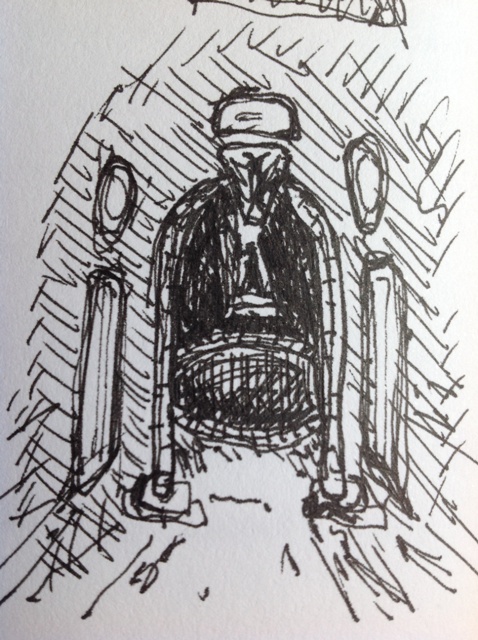
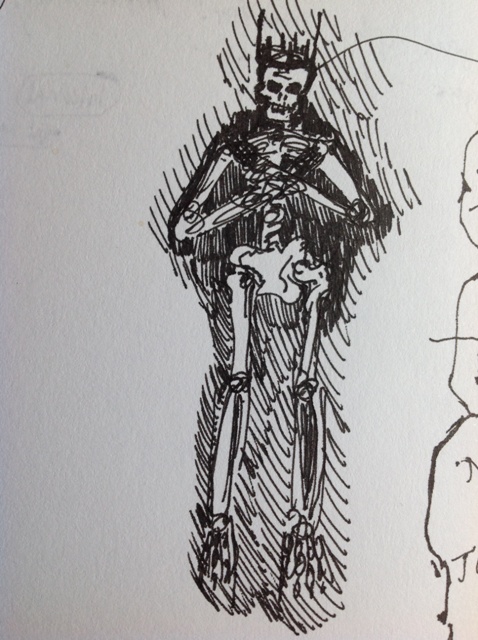
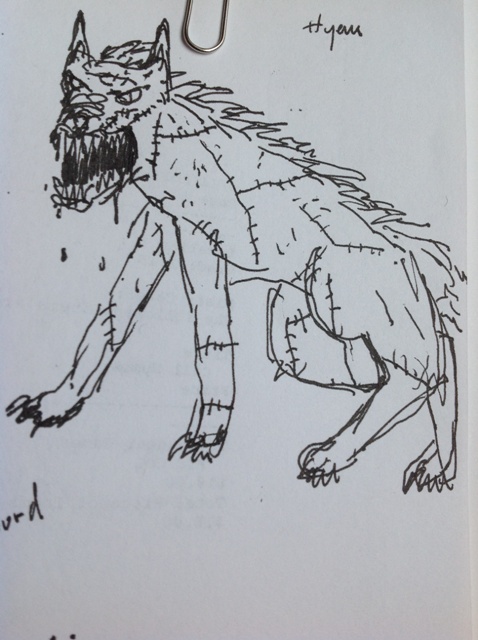
Today I thought it would be fun to take a look at a few sketches from recent chapter outlines and do the math to figure out how many words a picture is really worth. In most cases there were multiple little sketches per chapter, so I took the number of words in the completed chapter and divided by the number of sketches. Here are a few pictures with their associated word counts.

2014-04-09 09.52.41

481.8 words

2014-04-09 09.54.39

298.4 words

2014-04-09 09.56.57

509 words

2014-04-09 09.57.45

410 words

2014-04-09 09.57.58

679 words

When I averaged everything up it turned out a picture is actually worth about 445.33 words. It was a lot less than a thousand, suggesting that pictures, while incredibly useful, may be slightly overrated. However, this was a very limited study of only a few sketches made by a single writer for a small sample of chapters. More research is needed.

Surely this doodle is worth a thousands words, but I haven’t written the chapter yet.

2014-04-09 09.59.25

*First published on ShadowSpinners, April 2014.

“Buyer Beware” to be translated into Italian

fantasy-jewelry-3My body swapping, sci-fi farce “Buyer Beware” will be translated for the Italian language magazine DUDE. The story was previously published in Every Day Fiction, and the English language version can be read there.

I’m excited to have another story translated, and to reach a new audience. The online magazine is beautifully designed, and appears filled with fiction and various culture pieces. No word yet on when my story will appear, but I will post when I know more.

Read “Buyer Beware” on Every Day Fiction

public_domain_astronomy_25“Buyer Beware” is now up at Every Day Fiction. This very short story follows the professional woes of Trader Klorg and some personal complications that arise during the trans-galactic trading convention. What can I say, unregulated interstellar trade has its drawbacks.

Hope you enjoy the story! Please share, rate, and review if you have a chance.

“Buyer Beware” to appear in Every Day Fiction

My body swapping sci-fi farce “Buyer Beware” will appear in Every Day Fiction sometime in the next two months. This is one of the most comedic stories I’ve written, so it has a special place in my mind.

Readers of my horror stories may be surprised by the ending, but I think there is still a touch of the weird and strange in this tale of a body swapping alien and the woes of unregulated interstellar trade.

Will post again once the story is up. In the meantime, check out Every Day Fiction. They post a short story every day, always under a 1000 words.

A Strange Habit

writer's deskThere’s a story that Robert E. Howard used to envision the ghost of King Conan behind him, ready to lop off his head with an axe if he didn’t keep writing. Never mind that this is probably an apocryphal story. It’s still a great image, and whatever Howard was doing to get his stories written, it worked!

Work habits are a subject of endless conversation when it comes to the creative process of writers. Numerous books and excellent teachers suggest various methods of accomplishing the noble goal of putting words on a page, and offer plenty of encouragement along the way. The most consistent truth, however, is simply that writing is hard work and the methods for getting that work done vary from writer to writer.

I have a lot of tricks to keep me writing: new locations, graph paper, computer setup, a cup of tea, timed sessions, word counts, and so on. We develop habits, of course, particular to our individual sensibilities. Sometimes these habits become rituals, even obsessions. There’s plenty of room for eccentricities.

Hemingway wrote standing up. Nabokov wrote everything on notecards. Ibsen wrote in the presence of a giant oil painting of his greatest rival. Hugo wrote naked, and had his valet hide his clothes to ensure he wouldn’t go out. The ancient Greek writer Demosthenes accomplished the same thing by shaving one side of his head before beginning to write. The list goes on, from Balzac’s coffee and lucky monk’s robe, to Dickens’ ritualized desk arrangements, from Dumas’ fresh apples to Schiller’s rotten apples.

As it turns out, there’s even some neuroscience to explain why these weird rituals work. Like a Pavlov’s bell, rituals associated with writing may cue creativity and productivity. (See “Why Weird Writing Rituals Work” by Rosanne Bane)

Most of the habits of writers we will never know, because they are done in solitude. But the purpose of some seemingly strange behaviors is almost always the same, and that is to help one engage in the most important habit of all: actually writing.

*First published on ShadowSpinners, June 2013.

“Old Growth” eBook Available Now

ogA young botanist finds more than than he bargained for when he enters an ancient forest in search of a new species of tree. A horror awaits him in the heart of the old growth.

“Old Growth” is now available as a .99 cent Kindle eBook. First published in AlienSkin in 2009, this story links the Pacific Northwest with many of my other horror stories set in Auxerre, Wisconsin.

As I said in an earlier post, this story was inspired by a conversation I overheard. Two girls were talking about how they were afraid to go into the woods behind their house. They were really scared and it stuck with me. A couple of months later this story was born. There’s a lot of woods in Oregon, and some say deep in the old growth, are strange things still unknown to man.

Happy reading! Please share, post, and review if you get a chance.

“Old Growth” Ebook Coming Soon…

og“Old Growth” will soon be released as a short story ebook!

This story got its start when I overheard some girls talking once about how they were afraid to go into the woods out back behind their house. There’s a lot of woods in Oregon, and it struck me as odd that they would be so afraid of something in their own back yard. But the woods are deep and old, and weird tales are told about the old growth.

This horror story links the Pacific Northwest with my other stories centered around the strange town of Auxerre, Wisconsin. It was first published in Alien Skin. Looking forward to sharing it with more readers.

Stay tuned for more release information.

Geography for Worldbuilding and Fantasy Maps

crusoeWhether you’re creating a setting for a novel, story, or game, it’s a good idea to think about some basic geography, so things make sense … for the most part anyway. I consulted a geologist about some basic guidelines for the geography of imaginary worlds. Of course, there are always anomalies, and fantastical explanations for unusual features or even entire worlds, but if you want your world to be vaguely earth-like, these simple guidelines may help in your worldbuilding:

  1. Large mountains almost always occur in ranges.
  2. Rivers flow from mountains and hills down into bigger rivers or open bodies of water.
  3. Forest can occur almost anywhere there is sufficient water for trees.
  4. Grasslands and hills can occur almost anywhere.
  5. Swamps, marshes, and lakes occur in flat areas with a lot of water.
  6. Canyons are carved out by rivers or streams.
  7. Major deserts are a regional function of the trade winds, but small deserts often form inland, on the far side of mountain ranges.
  8. Springs and oases can occur almost anywhere.
  9. Volcanoes occur in chains or regions of vulcanism. This usually happens closer to coastlines or islands.
  10. Glaciers, like water, flow downhill, and glaciated areas tend to have broad U-shaped valleys.
  11. Towns and cities need a source of fresh water. Larger cities often occur on trade routes.
  12. If you’re looking at huge timescales and you want some billion year old ruins, the centers of continents tend to be the oldest geologic areas.