Beautiful Corpses

About a year ago I did some extensive research on mummies and mummification for a story. This kind of research is one of the perks of writing fiction. I watched documentaries, read articles, and went to see one of largest collections of mummies ever assembled from around the world. I was a bit mummy obsessed for a while. I got my story too, and eventually wrote a bit on the subject that was first published on ShadowSpinners:
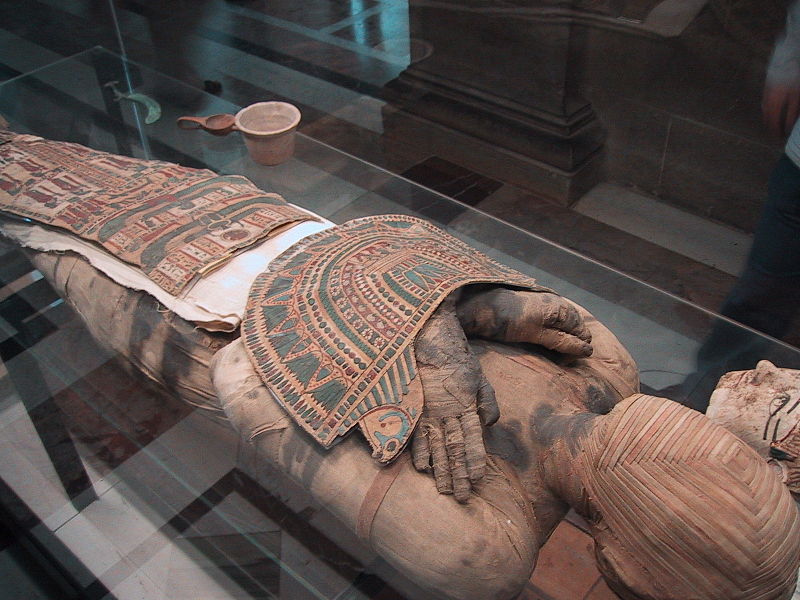
mummy
Photography (c) 2002 Zubro and released under GFDL

Beautiful Corpses

There’s no doubt death discomforts the living. A long history of adaptation for survival has assured we are repelled by the sight and smell of a rotting corpse, especially the corpse of human being. We are disturbed by possible threats to our well-being and reminded of our ultimate mortality. We are heartbroken at the loss of friends and family, and at the horrible absence a corpse represents.

Through the ages, we have developed countless ways of dealing with the dead. We have burned them on funeral pyres and interred them in lofty tombs. We have buried them in the ground and shelved them in catacombs. We have drowned them in the sea and left them on mountaintops for scavengers to pick clean their bones. Perhaps none is more fascinating than mummification, when the flesh of the living is preserved in death through the ages. The word “mummy” come from the Arabic word for bitumen, thought to be used in some Egyptian mummies, but different types of mummies exist from around the world.

To create a mummy the process of decay must be halted, usually though desiccation, but sometimes through chemicals, cold temperatures, or submersion in an anaerobic fluid. While many cultures deliberately mummify the dead, many mummies are a product of accidental conditions. In either case, once the body has stabilized, if the environment is favorable, a mummy may remain intact for thousands of years.

When decay ceases, and the grief of the living has passed into history, a strange beauty remains in the dead. You can sense this beauty gazing upon an ancient mummy. It’s difficult to put into words. This silent face … this still flesh … stirs thoughts of life as much as death, of hopes and dreams, of love and loss and longing. The beauty of this singular person, who walked the earth so long ago, is still here, like a shadow cast forward through time.

Ancient Egyptian culture flourished for 3000 years. An estimated 70 million people were mummified and entombed in the burning sands. For all that time, tombs have been broken into, desecrated, and robbed for the valuables they contained. In the 18th and 19th century, there thrived an international market for mummies as souvenirs and curiosities, and to be ground up and used in paints and medicine. They were even used as fuel for the fire on cold desert nights when wood was scarce.

Thankfully, these practices have ended, and mummies today, from Egypt and around the world, are being treated with care and respect. They are meticulously preserved and studied for the wealth of scientific and historical information they contain. And they are admired by those with an imagination for history, horror, and yes, beauty.

*First published on ShadowSpinners, August 2013.

On Finishing …

the endFor twelve years I have been working on a trilogy of fantasy books. In that time I have lived in two different countries, three states, and six different homes. I’ve had eight jobs, gotten a Master’s degree, and gone through one marriage, one divorce, and two deaths in my family. Through it all I have been writing, among other things, this single epic tale. During the process, moments of boundless enthusiasm and despair mixed with long periods of just moving forward, doing the work, writing the next scene, the next chapter, the next book.

Last week I wrote THE END. I finished the last chapter of the last book and sat back, stunned by the moment and the magnitude of what I’d done. I had before me a single complete story spanning 300,000 words, roughly 1200 pages, and the occasion has gotten me thinking about finishing things, and endings in general.

I’ve talked with a lot of new and young writers who say they enjoy writing, but have trouble finishing anything. The reasons vary. Sometimes writers get stuck on a problem they never solve, or lose interest in what seems like an idea that didn’t pan out. Sometimes their story isn’t really a story, but rather a series of events with no central conflict demanding an ending. Sometimes writers just lose faith, or have a moment of doubt that brings their work to a halt and they never go back to it.

If the problem is technical, there is probably a solution if you work to find it, but sometimes the problem is psychological, a reluctance, for whatever reason, to finish. Either way, if you’re passionate about writing, you must persevere to an ending. At the very least so you get practice writing them. We all know a story must have a beginning, a middle, and an end. That’s why writing short stories is such good practice for the craft as a whole. They provide an opportunity to practice endings nearly as much as beginnings and middles.

Elizabeth Engstrom says to “find your ending in your beginning.” I always think about this when I’m coming to the end of a story. It’s important to end the story you started writing, and not some other story you picked up along the way. A strong central conflict really helps make this clear. The end must match the beginning in a way, and I found this to be just as true in a 300,000 word story as in a 1500 word story. The end must deal with the same protagonist, issues, and conflicts introduced in the beginning. So if you’re searching for an ending, that’s a good place to start.

When you get there at last, there’s nothing quite like the feeling of finishing a work of fiction. There’s a bit of magic in fiction, a sense of creating something tangible from the nebulous dreamscape of your mind. And when the last sentence is written, especially if it’s a good one, there’s a sense of triumph and relief like no other. If your project happened to take twelve years like mine did, there’s also a bittersweet sense of loss. All the unwritten scenes and plot puzzles and character arcs I carried around with me day after day … they’re all resolved now. The story is finished.

The work is far from over, of course. I already have a number of other projects I’m working on, and in a week or two I’ll dive back in for more editing and rewrites. Eventually, I’ll start thinking about the next big project, and what I want to accomplish in the next twelve years!

_

*Simultaneously published on ShadowSpinners.

A Picture is Worth (x) Words

Everyone’s heard the saying “a picture is worth a thousand words,” but does it hold up when you’re actually counting the words?

Among writers, the subject of outlining seems to be a fundamental ongoing process question: to outline or not to outline, and also when, and in how much detail, in what form, and how closely to follow it. For the record, I’m a firm believer in outlining, and tend to make progressively more detailed outlines as a project unfolds. I also tend to sketch various ideas for the scenes I’m working on, and collect photographic references.

Visual references may not be talked about as much as outlining, but I think it’s a great tool, and at the recent Wordcrafters writers conference in Eugene, I noted both Terry Brooks and Elizabeth George talking about the use of visual references in their work. Mine tend to take the form of little maps or sketches of characters, visual details, or dramatic moments. I also look for ideas and take photographs at various locations, and use image searches on the internet.

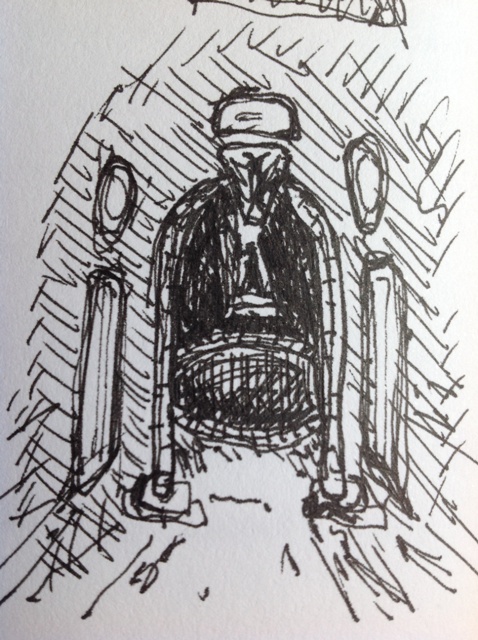
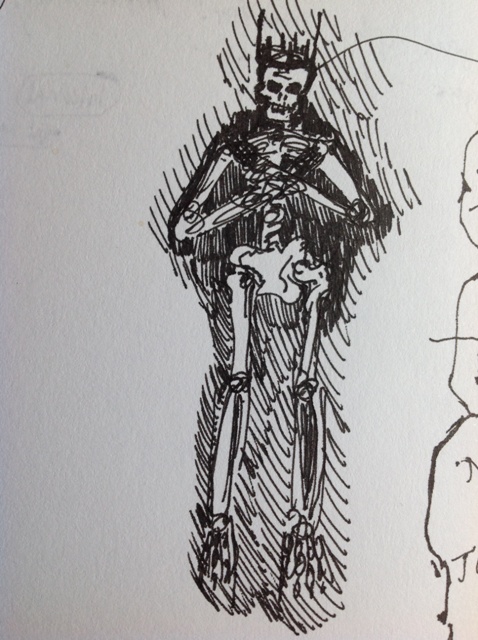
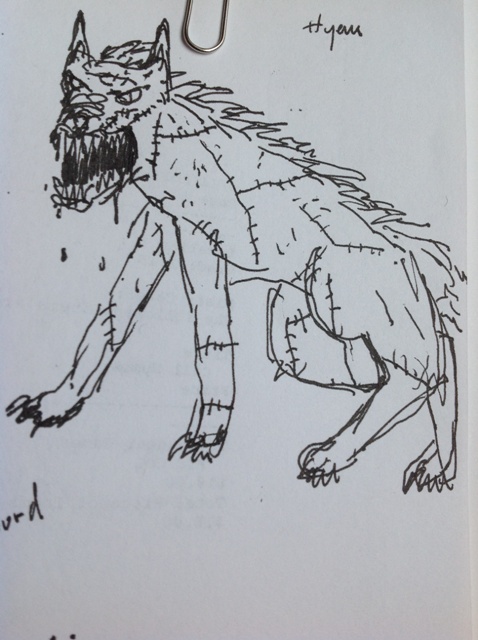
Today I thought it would be fun to take a look at a few sketches from recent chapter outlines and do the math to figure out how many words a picture is really worth. In most cases there were multiple little sketches per chapter, so I took the number of words in the completed chapter and divided by the number of sketches. Here are a few pictures with their associated word counts.

2014-04-09 09.52.41

481.8 words

2014-04-09 09.54.39

298.4 words

2014-04-09 09.56.57

509 words

2014-04-09 09.57.45

410 words

2014-04-09 09.57.58

679 words

When I averaged everything up it turned out a picture is actually worth about 445.33 words. It was a lot less than a thousand, suggesting that pictures, while incredibly useful, may be slightly overrated. However, this was a very limited study of only a few sketches made by a single writer for a small sample of chapters. More research is needed.

Surely this doodle is worth a thousands words, but I haven’t written the chapter yet.

2014-04-09 09.59.25

*First published on ShadowSpinners, April 2014.

“Buyer Beware” to be translated into Italian

fantasy-jewelry-3My body swapping, sci-fi farce “Buyer Beware” will be translated for the Italian language magazine DUDE. The story was previously published in Every Day Fiction, and the English language version can be read there.

I’m excited to have another story translated, and to reach a new audience. The online magazine is beautifully designed, and appears filled with fiction and various culture pieces. No word yet on when my story will appear, but I will post when I know more.

Dungeon map appears in French RPG eZine La Saltarelle

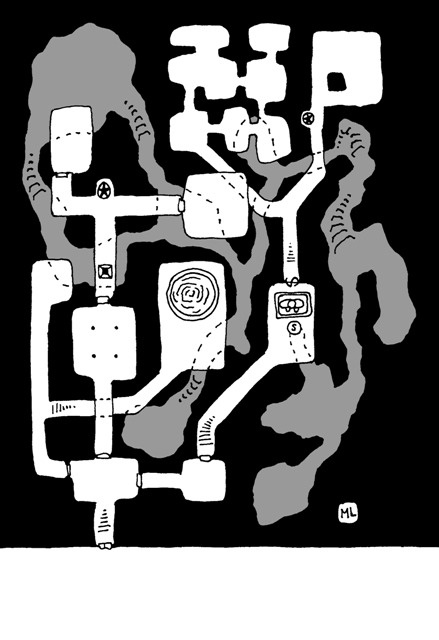
dungeon 002lwOne of my dungeon maps is now appearing in the French RPG eZine La Saltarelle thanks to editor, Fabrice P. This is a little dungeon I drew while experimenting with a stark black and white style. In this map I used gray in the lower caverns to add depth to the levels.

The map appears with a contest (pg 39). Readers can enter by writing their ideas for the history and inhabitants of this dungeon and sending them in. Top two entries will receive a copy of Temple du Dieu Néant or a paper copy of  l’Étrange Manoir. I’m pretty excited to see what people come up with!

There are a couple of different ways you can check it out this eZine, and even if you don’t read French, there are some really cool illustrations to enjoy! You can read in an online reader, or download a zipped pdf.

For more information on this eZine, you can also visit the Editions La Saltarelle webiste.

Read “Buyer Beware” on Every Day Fiction

public_domain_astronomy_25“Buyer Beware” is now up at Every Day Fiction. This very short story follows the professional woes of Trader Klorg and some personal complications that arise during the trans-galactic trading convention. What can I say, unregulated interstellar trade has its drawbacks.

Hope you enjoy the story! Please share, rate, and review if you have a chance.

“Buyer Beware” to appear in Every Day Fiction

My body swapping sci-fi farce “Buyer Beware” will appear in Every Day Fiction sometime in the next two months. This is one of the most comedic stories I’ve written, so it has a special place in my mind.

Readers of my horror stories may be surprised by the ending, but I think there is still a touch of the weird and strange in this tale of a body swapping alien and the woes of unregulated interstellar trade.

Will post again once the story is up. In the meantime, check out Every Day Fiction. They post a short story every day, always under a 1000 words.

Dungeon Map Symbols

“Show not what has been done, but what can be. How beautiful the world would be if there were a procedure for moving through labyrinths.”

— Umberto Eco, The Name of the Rose

dungeon symbols

pdf version – click here

The labyrinth, the dungeon, and the mythic underworld are all time honored traditions in story telling and games, from Theseus and the Minotaur to the “Tomb of Horrors,” from Galouye’s Dark Universe to the mines of Dwarf Fortress. When you start thinking about underworld settings the examples are really innumerable.

Growing up I spent uncounted hours drawing dungeons and labyrinths to use in stories and games. I was always fascinated by the icons and symbols used in maps to represent various things, and symbols for dungeon maps were no exception.

I’ve continued to use my map drawing experience to sketch out settings for my stories and I recently gotten back into game maps. Above you will find my own key to various dungeon symbols for any like minded cartographers out there.

Here’s some examples of my game maps:

grand entrancewater dungeonwizard's lair

*Update 8/26/2015: Posted a key for my simplified symbols for area and wilderness maps.

A Strange Habit

writer's deskThere’s a story that Robert E. Howard used to envision the ghost of King Conan behind him, ready to lop off his head with an axe if he didn’t keep writing. Never mind that this is probably an apocryphal story. It’s still a great image, and whatever Howard was doing to get his stories written, it worked!

Work habits are a subject of endless conversation when it comes to the creative process of writers. Numerous books and excellent teachers suggest various methods of accomplishing the noble goal of putting words on a page, and offer plenty of encouragement along the way. The most consistent truth, however, is simply that writing is hard work and the methods for getting that work done vary from writer to writer.

I have a lot of tricks to keep me writing: new locations, graph paper, computer setup, a cup of tea, timed sessions, word counts, and so on. We develop habits, of course, particular to our individual sensibilities. Sometimes these habits become rituals, even obsessions. There’s plenty of room for eccentricities.

Hemingway wrote standing up. Nabokov wrote everything on notecards. Ibsen wrote in the presence of a giant oil painting of his greatest rival. Hugo wrote naked, and had his valet hide his clothes to ensure he wouldn’t go out. The ancient Greek writer Demosthenes accomplished the same thing by shaving one side of his head before beginning to write. The list goes on, from Balzac’s coffee and lucky monk’s robe, to Dickens’ ritualized desk arrangements, from Dumas’ fresh apples to Schiller’s rotten apples.

As it turns out, there’s even some neuroscience to explain why these weird rituals work. Like a Pavlov’s bell, rituals associated with writing may cue creativity and productivity. (See “Why Weird Writing Rituals Work” by Rosanne Bane)

Most of the habits of writers we will never know, because they are done in solitude. But the purpose of some seemingly strange behaviors is almost always the same, and that is to help one engage in the most important habit of all: actually writing.

*First published on ShadowSpinners, June 2013.

“Old Growth” eBook Available Now

ogA young botanist finds more than than he bargained for when he enters an ancient forest in search of a new species of tree. A horror awaits him in the heart of the old growth.

“Old Growth” is now available as a .99 cent Kindle eBook. First published in AlienSkin in 2009, this story links the Pacific Northwest with many of my other horror stories set in Auxerre, Wisconsin.

As I said in an earlier post, this story was inspired by a conversation I overheard. Two girls were talking about how they were afraid to go into the woods behind their house. They were really scared and it stuck with me. A couple of months later this story was born. There’s a lot of woods in Oregon, and some say deep in the old growth, are strange things still unknown to man.

Happy reading! Please share, post, and review if you get a chance.